Sunday, March 25, 2012

Tassie - Heritage Hwy

Woolmer's Estate near Longford.
Driving along Tasmania's Heritage Hwy from Launceston to Hobart, is like a drive through an Australian history book. The highway is one old convict building after another. Some remain as magnificent private residences, others as working farms, some have become cafes or bakeries or gift shops, some of the grand homes are now tourist attractions allowing us to share their history, whilst others are just ruins from a time long past.
We started our history lesson at Longford, a short drive from Launceston, and 200 years ago. It is a lovely heritage town, full of history and old convict built buildings. The Longford Riverside Caravan Park, is beautifully positioned on the banks of the Macquarie River, and very well run. It is also only a short walk into town, and the fantastic JJ's Bakery, which got a few of our dollars! Fantastic wood fired bread!
Clarendon House near Evandale.
Entally House near Carrick
To understand the heritage of the area we first had to get an understanding of the major role played by convicts in the history of Tasmania, and Australia. We soon realised just how dumb we were, when it came to our own history, so excuse us while we indulge ourselves on new found knowledge. Of the 160,000 convicts transported to the colonies, over 70,000 came to Tasmania. Most were petty criminals, forced into crime in the UK, usually as a matter of survival. Sure there were hardened criminals, but they were in the minority. Most of the convicts were sent out to work with the free settlers, again most of whom were not originally wealthy or titled, but opportunistic and smart. They used the free labour to become wealthy very quickly. The convicts were here with short sentences, usually around seven years, and were quickly released, many with grants of land, so Tasmania prospered, as they tried to turn it into England in the southern hemisphere. Non English things were wiped out, with bounties on aboriginals and Tasmanian tigers, and English things introduced, such as plants and animals. Imagine the ecological consequences. They were very successful at what they set out to do. The huge stands of conifers, the thousands of rabbits, and the fact that the fox now has a bounty on it, are the results of that plan. Unfortunately, the extinction of the Tasmanian aboriginal and the Tasmanian devil also happened very quickly.
The National Rose Garden at
Woolmer's Estate.
The three homes shown in the pictures tell the stories of three such families, who became wealthy farmers and landowners, who held high office in Tasmania, even becoming Premier of the state. At Woolmer's Estate, and its neighbouring property called Brikkendon, World Heritage Listing has been bestowed, along with nine other sites in Australia, recognising the contribution, of forced convict migration on the development of the modern world. These are UNESCO sites, similar in standing to those we marvelled at in Europe, yet didn't even know existed in our own country.
In addition, at Woolmer's Estate, the National Rose Garden has been established, and what a magnificent site it must be in full bloom. We missed it by about 2 months, but what we saw was still a great sight. The Queen has also taken tea at Woolmers Estate.
Begonia at Entally House.
Entally Estate is worthy of mention for the fact that it was built by the Rieby family. Most of you will be equally as ignorant as us, in not knowing that the chubby cheeked lady in the bonnet, on our $20 note, is Mary Rieby, ex convict cum early entrepreneur. Well, her son came to Tasmania on one of the family trading vessels, managed to get some free land, and the rest was history. One of his descendants became Premier of Tasmania. This property has one of the earliest glass hot houses in Australia, and houses one of the best begonia exhibits we've ever seen, as well as having one of Australia's earliest cricket ovals, still there today.
It doesn't matter where you drive around this district, you will find historic properties to stop at, and ponder the past.
Morning tea at the Red Bridge Cafe
Leaving Longford, we drove a short distance down the highway to another Historic Town, Campbell Town. Along the way you just see one old convict home after another. In Campbell Town there is another one of those amazing convict built road bridges, still in use today on the main highway. Next to the bridge is the Red Bridge Cafe & Providore. Carol had a cutout from a newspaper, so I knew we would be calling in for a "Tub of Love". Of all things imaginable, this is actually a ready made dip, and it lives up to its name. This is not the only thing we purchase! The weather has turned really cold, with snow down to 600 metres. We need a break. They make all their own cakes, beautiful coffee, and they have an open fire.The rest is history! The vanilla slice comes freshly baked from heaven daily, and the carrot cake takes over the mantle as best yet!
On the convict bridge at Ross.
Suitably warmed, we head on to another quaint historic village, called Ross. It is gorgeous, with its magnificent tree lined streets, and scores of sandstone buildings, and yes it has a convict built sandstone bridge! By now, cold has turned into freezing, with the rain showers falling as small hail, and a strong breeze adding to the torture, as we walk the historic streets, resembling Mr and Mrs Michelin man. The thermometer says 4 degrees, but it is a known liar! Ross was home to one of the few Women's Prisons in Tasmania. Their history, really makes for some sad reading. Boy did they have a tough life.
pussys, has him purring like a baby, dreaming about those poor women prisoners, and the poor bloody bikies in their one man tents, just across the way. Their skin was so blue you could hardly make out the tattoos!
Morning has broken, and at least the sun has come up. Unfortunately, the temperature has not. Thankfully, we had stayed hooked up for the one night stay. The Ross Caravan Park is right in town beside the river, and next to that bridge, so we can walk the village. This means that getting going is quick and easy.
The mill at Oatlands.
First stop down the road is Oatlands, home to the only working flour mill in Australia, driven by a windmill. It is a very impressive structure. You can buy milled flour at shops in town. The rest of the town is another collection of wonderful old convict buildings, probably the biggest collection we've seen, and mostly B&B's, cafes and gift shops. It is a lovely little town, and we take morning tea at a delightful little crepe & pancake cafe, that is beautifully decked out as old English, and is complete with fine china cups and plates. Cosy & warm with its gas fire, it is hard to drag ourselves back out into the cold, but we do, and set course for Hobart, just a short drive away. More heritage homes along the way. It is a trip we have really enjoyed. If you wanted to explore the history of this drive in detail, you could spend weeks, but alas we do not have the time, as we are on our way to the Huon Trail, south of Hobart, as we enter the final part of our Tasmanian visit.


Monday, March 19, 2012

Tassie - Cradle Mountain & The North West.

We have just completed two lovely weeks travelling around Tassie's North West with John's sister Jenny, and her husband David. They flew into Launceston on Monday 5th March, and we farewelled them at 6.30am from Stanley, on the 19th March. Yes, that is correct, it was 6.30am, as they had to drive back to Launceston! In between we have had two action packed weeks, seeing as much as we could on the North West of this amazing little island.


Platypus at Platypus World.
Seahorses at Seahorse World.
First up was the beautiful Tamar Valley. A drive up to Beauty Point gave us the chance to catch up with a few Tassie locals.
Echidna at Platypus World.
We visited Platypus World and Seahorse World, conveniently located on the same wharf at Beauty Point. At both venues, you do guided tours, and get to have close up and personal encounters with the little creatures. At Platypus World we were also able to play with the echidnas, so it was a great way to learn about these little critters that are plentiful all over the island. The seahorses were fascinating. The centre breeds them commercially, both as pets and for export to Asia. We saw them from tiny, to fully grown, and in a variety of colours. Fascinating!
The Beaconsfield Mine rescue.
Next day we were at Beaconsfield. We all remember those images of the two guys emerging from the Beaconsfield Mine after having been entombed for weeks. They have done a wonderful job of building the Mine Heritage Centre, which is a wonderful walk through the history of the mine, the district and that amazing rescue. We lost a lot of time walking around here, and yes the mine is still working.
No trip to Launceston is complete without a visit to the Cataract Gorge, situated just 5 minutes from downtown! It is a spectacular sight. The suspension bridge and chairlift are icons of Tasmania, and the gardens are lovely. It is also home to a large population of peacocks, that are very tame, and turn a visit to the open air cafe, into a battle of survival. Turn your head for a moment and your raisin toast is gone!
A visit to the Swiss village of Grindelwald, sounded lovely, but proved a bit disappointing, as it was run down and very tired, except for some nice gardens. Likewise, we cancelled a visit to the famous Bridestowe Lavender Farm, as it had just finished harvesting, and as the lady at the visitor centre said, "not worth driving all that way to look at fields of stalks!"
Dove Lake at Cradle Mountain.
Cute little Eastern Quoll.
On Friday, we headed up to Cradle Mountain. Carol & I stored the caravan at the caravan park in Devonport, we would be returning to after a weekend at Cradle Mountain, and we all piled into Jenny & Dave's rental car for the short trip up the mountain. We had decided to spoil ourselves for the weekend, and had booked Spa Suites with log fires at the famous Cradle Mountain Lodge. It is a lovely drive up the mountain, but as you get close to the National Park, the landscape changes to open plains and lots of dead trees. Apparently the dead trees are the result of no termites in Tassie, and the colder climate meaning a slow rotting process. We arrive at Cradle Mountain Lodge, check in, and drove up to our rooms in the wilderness. The place is really spread out with the cabins quite some distance from the lodge. Still they are spacious and very comfortable, and with the night time temperatures in single figures, John gets the fire going. Doesn't take long before the room temperature is approaching 40 Celsius, and we have to open the doors to cool the place down!!
Dinner tonight is at the Tavern, as we have an 8.30pm tour booked at Devils @ Cradle, for a real close up with the Tasmanian Devils and Quolls. It was a great tour, very informative and a very close encounter, in drizzly rain.
Pencil Pine Falls.
Jenny & Carol on the stairs
to Knyvet Falls
The next morning dawns clear and bright, so we head for the Cradle Mountain Visitor Centre. Traffic is limited in the park, so shuttle buses are the best way to get to the various walks. We have decided on doing the Dove Lake Walk, about 3.5 hours of travel around the beautiful lake set in the cradle of the mountains. What a treat. This is World Heritage listed wilderness, and it is breathtakingly beautiful in a harsh kind of way. The walk is on a well worn track, up hill and down dale, right beside the lake and then up above it, through some rain forest and along some boardwalks and wooden stairs. It is a delight at every turn, and on a beautiful cool, but sunny day, we meet a lot of people, and the odd bit of wildlife, along the way. At the end of 3.5 hours, we are all tired, but very happy having completed a magnificent walk. Back on the bus we head back to the Interpretation Centre, which has some great exhibits, and do a short walk to Pencil Pine Falls, which are lovely. Another short walk back to the Lodge, and spas all round!! What a day!! Throw another log on the fire, and it's time to head down to the fine dining restaurant, Highlander, for a great meal. The huge log fire is roaring away, creating a fantastic atmosphere. A really lovely night. Back at the room, the heater is still on 40 and Carol starts peeling off the layers, as John throws another log on the fire!!
Next morning is drizzly and cold. We check out, and head across the road to do a shortish walk to Knyvet Falls. What a walk. It is only about an hour, but is down stairs and along boardwalks through mossy and ferny forest. It is the forest from Lord of the Rings, and we are all blown away by the tranquility and beauty of what we have been lucky enough to see. The falls were pretty good too!
Steam Fest - Old Steam Engine
So all back into the little car, and back down the mountain to Sheffield. This is one busy itinerary, and we are on our way to Sheffield, the mural town, covered in one of our earlier postings, but this time it is not the murals that are the focus of the visit, but Steam Fest, an annual celebration of steam engines and old machinery. The clouds have gone and it is bright and sunny, and the show is terrific. From ploughing the fields with a horse drawn plough, to heaps of fantastically restored steam engines, a steam train doing rides, good old fashioned tractor pulling, bands, people in Medieval Clothing, crafts, vintage cars and food of all kinds, it was a great afternoon. Dave even had a go at archery, and hit the target every shot! Good one Dave.
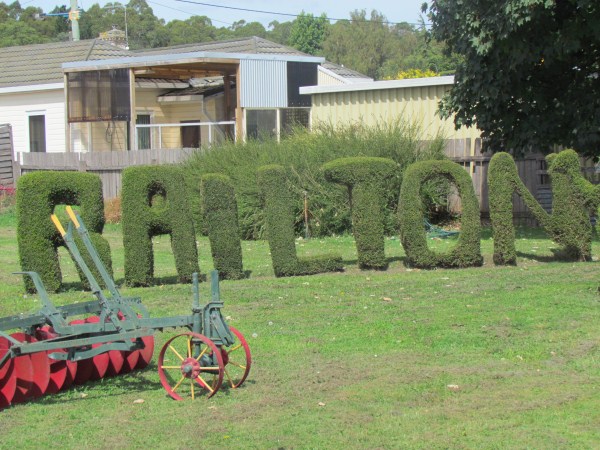
Railton - Topiary Town.
We finally made it to Devonport, where we had a catch up day. Jenny & Dave did Latrobe, covered in an earlier post, and we ventured back to Sheffield for Jenny & Dave to have a look at the murals, and finished with a round trip through Railton, the topiary town. We got the impression that the locals once really embraced the idea, but had lost a bit of interest. There were some good examples, but it was poorly sign posted, and we really only fell upon the best display by good luck. Deloraine was last stop on this part of the trip, with its lovely craft shops, deli, and galleries.
Next stop Wynyard, where we stayed at a lovely little caravan park called the Beach Retreat Tourist Park. Weather went pear shaped, with lots of wind and rain, so we spent most of our time indoors at the Makers Mart at Burnie, and having lunch at a fine old pub in the centre of town. We were all pretty underwhelmed by Burnie and all its industry.
Stanley & The Nut.
Last venue on our two week interlude was Stanley, also covered in an earlier post, so this time will only talk about the new things we did. This is a great little old fishing village set under the imposing monolith, The Nut. It is also the crayfish capital of Tasmania, but at $85 to $90 per kilo, the only ones buying were the few Japanese tourists in town. As you can see from the photo, the weather had improved greatly, as we took a drive around the district. It is all rich farming land, with lots of big dairy farms being the dominant feature. We took drives up the road to Smithton, the nearest larger town, which had a lot of industry, especially timber and dairy related, and back down the road to the gorgeous beach side hamlets of Boat Harbour and Sisters Beach. Boat Harbour is one out of the box. The white sandy beach and turquoise water, set in between the rocky headlands, is one of the prettiest beaches we have ever seen, in Tasmania or anywhere for that matter, and right on the beach is the Jolly Roger Restaurant, that forces you to sit down and drink in the view, as well as the Pinot Gris and the Caesar Salad, or Fish 'n Chips. Some one has to do it!!
On our last Saturday night, we decide to spoil ourselves with a delicious dinner at Xanders Brasserie, set under the imposing Nut, and with delightful views out across the town and the bay.  It will be our "break up party", and the food and wine was wonderful, which when combined with the view and the overall ambience, made for a special night for us all.
"The Edge of the World"
At Turks Landing for lunch.
White breasted Sea Eagle.
Bush BBQ on the Arthur River.
One last treat in store, was a cruise on the Arthur River. If you have a look on the map, you will see that Arthur River is set on the rugged, and remote, West Coast. It claims to be "the edge of the world", as standing on the cliffs at the entrance of the Arthur River, there are thousands of kilometres of ocean before the next land at South America. Thankfully, our journey was to be up river! We climb on board the red boat, whose last owner might have been Humphrey Bogart, and are introduced to the crew. When the owner;s name is "Cagey" and the captain's name is "Wog", you just know it is going to be a great day. There is a qualified, and very passionate, environmentalist on board, Greg, who gives a fantastic account of the history of the region, as well as the plants and animals of this true wilderness area, known as The Tarkine. Towering gum trees, rain forest and that black tannin stained water. It is truly awe inspiring. We get to see the magnificent white breasted sea eagle up close. There is a mum, dad and young one. I just love those big birds of prey! We travel upstream for 14 kilometres to a place called Turks Landing, which is just a metal gantry sticking out of the bush, where we all do a walk through the bush for a first hand chat with our enviro guru, Greg. While all this is happening, Cagey and Wog are cooking up a terrific Aussie BBQ at the bush camp site, where we share lunch with a wallaby or two and a couple of cheeky currawongs. It just doesn't get any better than this! There are lots of yarns, and lots of laughs, plus a cup or two of wine, and Cagey knows how to stir up trouble, so the whole day, 5 hours in total, just flys by. If you didn't enjoy this day out, you're dead!!
Back in Stanley, the sun is shining on The Nut. We've had a fantastic couple of weeks, and seen and done a lot. One last visit to Hursey's Fish & Chips, on the waterfront, a slow walk back around the bay while the sun sets, and it is early to bed for that 6.30am departure!

Sunday, March 11, 2012

Tassie - East Coast - Bicheno and Freycinet Peninsula

Leaving the old world charm of Richmond behind, after one last coffee at our favourite spot of course, we headed for Tasmania's iconic East Coast. Here are the world famous wilderness areas of the Freycinet Peninsula and the Bay of Fires. The scenery is spectacular.


We reach the coast at the small seaside village of Orford. Just up the road is the larger (but still small) town of Triabunna. These are mostly fishing and holiday destinations, as well as being the departure point for the Maria Island National Park. This island holds a large place in Tasmania's convict past, as it its first role in western society was as a penal settlement. These days it is reserved for nature walks, cycling and camping. You can even spend the night in a convict cell, similar in size to a phone booth lying on its side!!! We opted for a little more comfort.


Further up the coast we took our lunch stop at a lovely seafood cafe in the township of Swansea. This looked like a very nice town, with a strong fishing and seafood emphasis. Maybe come back and spend time later, if we have any left with so much to see.


A little further, and we reach our next home for a few days, Bicheno. The Bicheno East Coast Holiday Park is very nice. Right in town, means we can walk to everything, and the little town has a nice feel about it. It is a real seaside holiday place, with just enough shops and attractions to keep you satisfied. Some really nice cafes, a gourmet butcher & seafood shop, and a great bakery. We really liked it. This would be our last port of call with Lynne & Paul. Hard to believe that the three weeks was almost over. Still there was lots to do before they headed home.


John, Carol & Rastas on the
Wineglass Bay Cruise
First priority was Coles Bay and the magnificent Freycinet Peninsula, and yes, a visit to the iconic Wineglass Bay. We booked on board Wineglass Bay Cruises, and on a sunny but cool day, together with about 30 other travellers, headed out across the wide expanses of Great Oyster Bay. On board is Rastas the dolphin spotting dog. His antics were worth the price of the cruise! Every time someone said dolphin, he would race to that part of the boat and peer out across the water, ready to bark at the first sighting. Sadly it never came.The backdrop of the Hazards Mountains and that sparkling turquoise water is amazing. There is bird life everywhere. Eagles, Falcons, Albatross, Mutton birds, and countless gulls and terns, even a few shy penguins. We stop at a number of spots of historical significance, and then head out through Schouten Passage and the open sea.


The cliffs at Coles Bay
The cliffs along the coast are a different colour to those we saw further south near Bruny Island, but nonetheless spectacular. We get in real close in the Noosa Cat vessel, to see the caves and cuttings made by 1000's of years of water torture. We continue along the coast and enter Wineglass Bay. The white sand, the colour and the clarity of the water, immediately hit you. It is easy to understand why it is rated one of the most beautiful beaches in the world, and as it is only accessible by sea or a 3 hour hike, you get a lot of beach to yourself! We anchor in a quiet corner of the bay and enjoy some great Tassie cheese, a glass of Tassie Sparkling, and the skipper shucks some fresh local oysters to try. Not a bad life really!! Rastas is banned to the rear transom of the boat, where like the well trained fella he is, he sits quietly, thus avoiding the temptation of 30 plus people feeding him leftovers!! What a great day we had. However, the skipper did knock the romantic notion off the scene when he told us how Wineglass Bay was named. It used to be a whaling station, and when they were very successful and and the poor unfortunate victims were being slaughtered, all the blood washed into the bay, turning the waters red. From the mountains above, the bay resembled a glass of claret!!!


John & Carol with that iconic view.
After the cruise, Carol & John decided we just had to do the climb up to the lookout, to get to see the iconic view. We huffed and puffed (mostly John) our way up the hill, and the 300 steps, to the lookout. The return trip was about 2 hours, but so worth it. The view, on a perfect day, was amazing.


We did the sights around Bicheno. We were getting some mixed weather. We had some lovely days, then the temperature got up to 38C, followed by sea fog and then the freeze returned. The coastline is beautiful, but the water temperature is too cold for us to swim. Paul did take Harley for a swim at Binalong Bay. He told us the water was fine, but given that his body colour resembled a smurf, we didn't believe him!! We drove out to St.Marys, via Elephant Pass, home to the famous Pancake Cafe. We stopped and sampled the fare, which was excellent. They come sweet and savoury, and are the biggest pancakes we have ever seen! We were really glad we didn't have the caravan in tow. Elephant Pass didn't look like a regular caravan route! We also stopped in at St.Helens and Binalong Bay, the gateway to the Bay of Fires, but more about that later, as we stayed here for a few days after Lynne & Paul headed back.
Break up party in Bicheno


Last night in Bicheno, we opted for a break up party at the caravan park, so out came the Weber, and with help from the gourmet butcher and Carol, a sumptuous feast of roast shoulder of lamb was enjoyed by all. Sadly, the next day Lynne, Paul and Harley were all packed up, and the camper trailer headed out of Bicheno, headed for Devonport and the return voyage to the mainland.


John & Carol near Bluestone Beach.
We liked Bicheno, and decided to stay an extra few days. We also had another fun day planned. John had been given a voucher by his family for his 60th birthday, and the plan was to do something a bit different. A quad bike tour through Coles Bay National Park. www.all4adventure.com.au gave us 4 hours of adrenaline filled fun. Turned out we were the only two on the tour, so we got a personal tour with our guide Ben! After a short bit of training we headed out into the park, along the fire trails. What a day we had. We bounced and twisted and bumped our way along, through creek washouts, over tree roots and rough tracks on the way to the beautiful Friendly Beaches for morning tea. All that white sand and blue water. Then up to the cliff tops near Cape Tourville lighthouse, for fantastic views of the rugged coast, and on to Bluestone Beach for lunch. All places you can only reach by hiking or biking. Ben was a fantastic guide. We would recommend this tour to anyone of almost any age.


For our last night in Bicheno, we enjoyed a lovely meal at Pasini's Pizza Bar and Cafe. Fantastic pizza washed down by a lovely Spring Vale Pinot Noir, from the winery just down the road. The Pinot Noir and Pinot Gris or Pinot Grigio here in Tassie are fantastic. We haven't had a bad one yet! A bit pricey, but excellent.


Next stop is St. Helens and the Bay of Fires, just 60 kms up the road.


Tassie - East Coast - St Helens and The Bay of Fires

The drive up from Bicheno to St Helens isn't a long one. Carol took a turn at the wheel. We both need to feel comfortable towing the van. The roads in Tassie are narrow, and very quiet from what we have been used to, so it is a great place for practice. As usual, she does a great job.


Beautiful East Coast Beaches.
We pass through the seaside towns of Four Mile Creek, Falmouth and Scamander.This is Tassie's premier surfing region, and also some excellent fishing is to be had in the estuaries and the sea. These are all small villages, with a lot of holiday homes, and so very quiet. This is summer, and they are still deserted! 
Scamander is also a centre for berries, and there a re a number of farms where you can either pick your own or purchase ready packed, and the choice of jams and pickles is endless. You can also stop in at wineries along the route or the IronHouse Brewery.


Arriving at St Helens we checked into the Big4 Caravan Park. It is a nice park set on a hill, but most sites have nice level pads. Our site is towards the top of the hill. It is large and grassy. We felt in need of some lazy days after the busy 3 weeks with Lynne and Paul, so decided to take it easy, and just have a lazy look around the area.


Personally, we liked Bicheno better. St Helens is larger, and has a much bigger harbour. It is home to a large fishing fleet that catches fish and lobster. There is also a thriving oyster industry in the bay, and you can buy the most delicious freshly shucked Pacific oysters for as little as $10 per dozen. Also great Fish & Chips at the marina off the old paddle boat. We just liked the feel of Bicheno more.


Binalong Bay - Southern End
A short drive away, is Binalong Bay and the Bay of Fires. At Binalong Bay are beautiful beaches  and a large area of nature reserve. The area known as Humbug Point Nature Reserve is lovely for camping and hiking, and there are numerous bays and beaches to explore. The cafe/restaurant across from the beach is a good one, and we enjoyed a good coffee and freshly cooked muffin for morning tea. But it is the scenery that really is the centre of focus in this area.


Along the Bay of Fires
A drive out along the road to The Gardens takes you out along the Bay of Fires. We drove down almost every little road to dozens of beautiful beaches. All along the way are the huge boulders of the headlands that separate the beaches. Many of them are covered in the red that characterises the seascape of the area. Like most people, we thought it was iron oxide or some other mineral, but in fact, it is a fungus that grows on the rocks.


It is along this road that we found a large number of lovely spots to free camp in caravans, motorhomes and camper trailers. Swimcart Beach, and Cosy Corner Campground No.2 were suitable for our big caravan, and are right on the beach. If time permits, we may get back here. It was cold and windy while we visited, and these are places for being lazy, as apart from the beach, there is little else to do, but fish, swim (brrrr!), or walk. 


Eddystone Point Lighthouse.
Cold & Windy at the Bay of Fires
Another drive took us out to Ansons Bay and Eddystone Point, supposedly Tassie's most easterly point. It was a dirt road, in need of some work. The corrugations in some sections, really tested the fillings in our teeth! Ansons Bay was spooky. Lots of old shacks, and the odd new shack. It appears to be a fishing destination, and we are guessing that these shacks fill up with men with fishing boats. I don't think Lonely Planet will be listing it any day soon!! At Eddystone Point, it was hard to miss the lighthouse. The point is at sea level, so the lighthouse is very tall, and one of the only ones we've seen that isn't painted white. It is an isolated spot, and was cold and windy when we visited. It obviously doesn't get many visitors, as there wasn't much tourist information to be found!


In town, we did the shops, which didn't take long at all! The tourists must keep their hands in their pockets around here! Our last day in St Helens had turned wet and windy, so we opted for Fish & Chips from the marina, along with almost everyone else in town! Still it was worth the wait.
Next morning, the weather gods were good to us, and eased the rain long enough to get packed and hitched. We had decided to take the windy road through Scottsdale. A neighbour had told us about some wood carvings along the way, that shouldn't be missed, so off we went, hoping they would be well sign posted!
Picture says it all!
Not far from town we saw a sign that pointed to "The Pub in the Paddock" and Pyengana Cheese Factory. We couldn't resist, so left turn and off to Pyengana. The Pub was what it said, but a bit treacherous for us to get the van in and out, so we headed back to the Cheese Factory, that housed the Holy Cow Cafe, complete with raging log fire! Just what we needed on a cold wet morning. We hadn't had much brekkieMoochanic" and "Accowntant". It was a funky little stop.


Says it all.
Amazing what you can do with
a chainsaw.
Back on the road, the drive was slow and wet, but very pretty up and down through the mountains. We came to the old mining town of Derby. We just didn't realise what a rich mining heritage this little island had. Quaint little town, nestled in a gorgeous valley on a river. We stopped at Legerwood to see the wood carvings. Someone at the caravan park had said they should not be missed. It was rainy and misty, and quite uncomfortable, but well worth the stop. The photo explains the story of the carvings. It was quite moving, and a wonderful tribute. We headed on to Scottsdale, a little town that time has forgotten. It was cold and wet and Carol craved soup. We went into a number of places but were told that soup doesn't go on the menu until after Easter. Try and explain that logic! Well, we found a nice little old fashioned cafe, full of old fashioned people being served by old fashioned staff. At the table beside us, two elderly ladies clasped hands and said grace when their meal was served. I think they said grace. Maybe they were just grateful their meals arrived!! It was wholesome and cheap, and we headed on to Launceston, in search of the 21st century
Launceston is Tassie's second largest city, and is set in a beautiful location in the Tamar Valley. The wine industry is in full swing around here, with a host of vineyards, and even a brand or two we recognised. Wonderful Pinot Gris and Pinot Noir in these hills!!
We quickly found our caravan park, the Launceston Holiday Park Legana, about 10kms north of Launceston, on the West Tamar Hwy. It is very nice and quite busy. We get ourselves set up and ready for Jenny & Dave's arrival the next day.

Thursday, March 1, 2012

Tassie - MONA

Ever heard of MONA? Well it is the hottest new venue in Hobart. It is the Museum Of Old & New Art, as well as a winery, micro brewery, restaurant & function centre.


Everyone is talking about it. You have to go see it. It is amazing. It is wonderful. Even the guy at the roadside fruit stall told us that we couldn't miss it. So off we went.


The MONA Building
The first thing that strikes you is the pricing. Tasmanians get in free, the rest of the world pays! Now is there a message in there?? The building is quite striking. Set along a headland of the Derwent River west of Glenorchy, it resembles a fortress, set among the vineyards. Quite medieval really.


It is quickly apparent that this is the domain of the arty farty. Lots of black and berets, lots of tattoos and body piercing, lots of colourful kaftans and big jewellery, red lipstick, and lots of "oh darling". And that is just the patrons!!


The exhibits are mostly new art, with a few old things thrown in, to add credibility. Many of the exhibits are designed to shock, and they do. Now I'm the first to admit that I'm not great on modern art. I can appreciate a Picasso and a Dali, and can usually work them out, but I really struggled to work out what was artistic about a machine that replicated the human digestive system. This was a working machine. They put the Sunday roast in one end, it went through a series of chambers all made from clear plastic, so we didn't miss one disgusting minute, and a curly poo came out the other end several hours later. Now that is Art!! And just to make sure we didn't miss the point, they had three different versions, each taking up a room.


The smartest guy is the one who has donated his back for a tattoo artist. He comes and sits, bent over in a window, to show off the ever growing artwork that is his back. It is planned to take 2 years to complete, and he will pocket a 6 figure sum for an artwork that can never be sold!


But my real favourite for wierd, was the lipstick art. Some "artist" had taken some blank stationery from a series of exclusive hotels. The artist then proceeded to paint lipstick on his anus, and then squat on the stationery leaving a series of pink smears on each page. These were then framed and hung on the wall in a line. I hope the artist is seeing someone for their condition. All those businessmen walking out of 5 Star Hotels with briefcases will never seem the same again. Is there lipstick and stationery in that case??? 


I could go on and on about the exhibits, but why. It was hard work for the senses.


The featured exhibit was by artist Wim Delvoye, described as a conceptual artist. I'd agree, nothing seemed finished!! I thought the best thing about his work was the way he knocked off the Walt Disney logo to make it look like his name. After that he lost me. I am always suspicious when the description explaining the artwork is bigger than the artwork itself!!! The whole exhibition was so far out there, that none of us could make the journey. Hopefully the aliens will return soon to reclaim their lost property. Shame some of it got bent on landing!


Anyway, the food, the wine, and the beer was good, and you can't beat the setting. Oh, and I figured out the pricing. If you charge Tasmanians, none of them would likely ever come back, and get the money off the tourists up front, because they surely won't be back!!


As we drove back we passed the roadside fruit stall guy again, I had a vision of him hanging on a wall with fruit and vegetables sticking out of every orifice. You know, it might just work!!! Must call MONA.


Sorry guys, MONA was a groaner for us.

Friday, February 24, 2012

Tassie - Hobart, Bruny Island, Richmond

What an adventure we are having. In Tasmania, it is reinforced around every corner.
The historic old bridge at Richmond
As the goose bumps slowly settled from our visit to The Wall, our journey continued on towards Hobart, and on to our next base, the historic old English town of Richmond. The drive down through the Derwent Valley, kept begging us to stop and look, and we just kept making notes of where to come back to if we have time. The area around New Norfolk seemed really nice.
We skirted around the northern side of Hobart, past the infamous Risden Prison, home to Martin Bryant, the Port Arthur mass murderer, and soon entered the Coal Valley, a rich farming and wine area, and into Richmond. We found the Richmond Cabin & Tourist Park, and settled in. It is a rustic Park, set among the trees, run by a very friendly and helpful manager, and is only 2 minutes drive into town.
Being one of the oldest towns in Australia, it is full of history and some of the best examples of early Australian architecture you will see anywhere in the country. Most have been well restored and now house shops or other tourist attractions, or have been converted to B&B's, of which there are a host to choose from. Our timing couldn't have been better, with Sunday hosting the annual Scottish Festival. Time to rediscover my old family heritage. Now where did I put that kilt and sporran?
The Cruise Boat
Suited up and ready for adventure
But first we had to attend to other tourist matters, and our first priority was the Bruny Island Cruise, run by Rob Pennicott. If you haven't read about this trip, you should google it. It is one of the world's great adventure day trips, and we have now been lucky enough to experience it. I will try and do it justice in a few paragraphs. Lynne and Paul's dog Harley, had been put into Doggy Day Care for a couple of days. 
We went through the gap at speed!!
It is without doubt one of the best organised tours we have ever been on. From the time we met the bus driver at the beautiful seaside town of Kettering, we knew we were in for a great day. The bus driver was Mick, a man with saltwater in his veins, and a personality and well practised humour, tailor made for the job. Turned out he was also to be our skipper on the boat. The bus takes the car ferry across from Kettering to Bruny Island, and then on a 40 minute journey down the full length of the island to our cruise departure point at Adventure Bay. The whole thing is a well oiled machine. Arrive at Adventure Bay where hot coffee and muffins are waiting (for a fee), then order your lunch (for a fee) so it will be ready for your return from the cruise, then onto the boats. On our day there were 4 boats, each carrying around 30 passengers. The boats are amazing, purpose built things powered by three 300hp outboards, incredibly fast and manouverable, allowing access within centimetres of the cliff face, and patting distance of the seals!
Relaxation without a care
Our weather was cold (14 C) and overcast, and you needed the orange suit and every thing else under it, as we literally flew along the coast stopping all the while to see caves and countless other attractions always looking up at those amazing granite cliffs looming above, only metres from the boat. Huge gardens of giant kelp clinging to the rocks that in many parts are teeming with bird life.
We reached the Southern Ocean, and a group of islands covered in seals. You smell these buggers before you see them. There are thousands clinging to the rocks, resting, sleeping or fighting. It is quite a show! The return journey is further out to sea, in search of bird life, and we are not disappointed as we see albatross, gannets, gulls and terns, and plenty of the more than 19 million short tailed shearwaters (mutton birds), that make the annual migration from the Bering Sea in Siberia, to have their babies and then return home. Ain't nature grand!!!
Mick, behind John pointing out
the oysters nutritional values.
Back on shore it is time for lunch. We are glad we ordered soup, not because we are hungry, just so we can hold the cup and thaw out! Back on the bus for home, but we make a couple of stops. An Oyster Farm with the fantastic name of "Get Shucked". A small tasting box last seconds, the sweetest freshest Pacific Oysters we've ever had! One more stop at the Bruny Island Smokehouse, for a taste of their fabulous smoked salmon and ocean trout, as well as wallaby and rabbit, which Mick assured us wasn't road kill. It was all good, but the salmon was great, and went into the bag for later on. 
We were soon back in Kettering, and the fantastic adventure was over, but the memories will last forever. We decided to finish off the day with a seafood dinner around the buzzing waterfront of Hobart's Constitution Dock. Two cruise ships departing, made for a carnival atmosphere, and we opted for Mure's Seafoods, Hobart's version of Doyles, as the venue for our meal and a celebratory glass of wine, to finish a great day. Well almost finish the day. We found the ice cream bar on the way out, so wandered the docks with delicious home made ice cream for dessert!
Pipe Band on the village green
at Richmond
Next day we were back in Hobart, as it was Saturday, and the famous Salamanca Markets were on. Everything from fresh produce to souvenirs, clothes, crafts and jewellery, this market is well able to make claim to being Australia's biggest and best. The day just disappeared. Lynne & Paul headed off early to pick up Harley, so Carol & I decided to hag around and watch the transformation, as Salamanca quickly returns to being the vibrant night scene of galleries, bars and restaurants, for which it is equally famous. The whole area reminds us of Sydney's Rocks and Circular Quay, and we felt right at home. We enjoyed browsing the galleries, had a couple of drinks at a lovely bar and then had dinner at a lovely little Indian restaurant at the far end of Salamanca Place. We have another week in and around Hobart over Easter, and will really give the place a going over then.

Not Happy Jan!
Upside down Tassie Devil!
Sunday was Scottish Day in Richmond. The weather cleared after some heavy overnight rain, and the bag pipes were in full swing early. There was a pipe band contest, tents with Scottish Clan information, a grand official opening by the mayor, followed by a mass band showing, and a dancing dog display that seemed to be a bit of a work in progress. Nonetheless it was all good fun. With the sounds of the bagpipes still ringing in our ears, we headed out to a local zoo to see what it was like, and hopefully get up close and personal with some locals, the Tasmanian Devils. We weren't disappointed. The zoo had some beautiful white lions, including a new cub which was full of fun, as well as a couple of Sumatran Tigers. In addition there were some good bird displays, a farm animal nursery and an interactive area where you could feed the wallabies, goats and sheep. We did get close to the devils at feeding time, which was most interesting as the young keeper introduced them as some of the dumbest animals on earth, and then set out to prove his point!
We have also done a day at Port Arthur, but really did not get to see it all, so we have been given convict "tickets of leave", which allow us to return at a later time to finish our experience, so I will do a separate story at a later date. We will also be back in Richmond, as Carol still has lots of shops to explore!! 
So off to Bicheno we go. Last stop with Lynne & Paul. Can't believe how fast it has gone.

Tuesday, February 21, 2012

Tasmania - West Coast Wilderness

We left Ulverstone and headed for the West Coast, and our next stopover at the beautiful village of Strahan. By Tassie standards, this is a long drive at just over 200km. We had been advised to follow the B18 from Burnie, and approach Strahan from the town ship of Zeehan, thus avoiding the long, steep, and very winding approach, from Queenstown. For caravanners, this is excellent advice, and we were very grateful, especially for our big caravan.


The village of Strahan
The drive was lovely. Firstly heading through beautiful farming country, before hitting the hills and tall timber. Our morning tea stop was the small mining town of Rosebery, where the cheese & bacon sausage rolls at the bakery proved a huge hit! Washed down with a good (not great!) coffee, and we were soon on our way again. The active Zinc mine, looms above the town. The mines of this area are supposedly Tasmania's richest, having estimated revenues in excess of $8 billion!


We are soon at the next mining town, Zeehan, named after the explorer Abel Tasman's ship. Once upon a time "the Silver City" was Tasmania's 3rd largest city. Now it still hosts an active mine, and a small population. There are some great old buildings such as the 1000 seat Gaiety Theatre, and the West Coast Heritage Centre that tracks the mining history of the region.


On the West Coast Beach near Strahan
From Zeehan it is only a short distance into Strahan. The countryside changes dramatically into scrubby coastal plains, which really surprised me. I had expected tall trees and forest all the way!  We pulled up at the Strahan Holiday Park, where our booking had been lost, and they had to do some fast work to rectify the problem. Thank God for Lynne's thorough bookwork! We were unable to be together, but just a few sites apart. It proved to be a very busy, pleasant caravan park, but very tight for big vans, with very limited parking. There was a lot of car juggling as people moved in and out!


Gordon River Cruise
In Strahan, we were blessed by the most beautiful weather. Given what we had heard about wind and rain and cold, we were so lucky! The two big local attractions, are the Gordon River Cruise and the West Coast Wilderness Railway. There are two operators running the river cruises. We chose the "red" boat, as we had been advised it was more informal, allowing access to the wheelhouse, and freedom of movement around the vessel, rather than a reserved seat for the day. What  a day we had!


Hell's Gate Lighthouse
The cruise starts by heading out to "Hell's Gate", the entrance to the waterway, known as Macquarie Harbour. Once through those gates, the next stop is South America. That's right, not South Africa, which shows how far south we are! It is a huge harbour, but it has a narrow (8metre), shallow (5metre) opening, restricting the size of vessel that can enter. Consequently it is not a commercial shipping harbour, other than for fishing and tourism. There are a lot of fish farms anchored in the harbour, some 280 of them, each one holding up to 12,000 fish, either Atlantic Salmon or Ocean Trout. That Tassal or Huon smoked salmon you buy at Woolies or Coles, probably comes from here.
The first white "tourists" to the area, were in fact convicts, who arrived in 1823 from Hobart, to start a Penal Colony on Sarah Island, a small island inside the harbour. This was pre Port Arthur. Their job was to be harvesting the huge huon pine from the forests and to build ships. These were the ones who named the harbour entrance, for obvious reasons. We enjoyed a wonderful tour of Sarah Island, with an animated guide, who ran the show like a play, with members of our group assigned characters from the history of the day, all as we moved among the ruins. It was a huge amount of fun. We could not believe how many people were housed on this small island. It closed in 1835 and everyone was transferred to the new penal colony at Port Arthur.
From Sarah Island, we headed for the Gordon River, along the way enjoying a fantastic buffet lunch of among other things, local smoked salmon and cheeses, washed down with some lovely local wines. As we headed up the Gordon River, we were reminded of the protests back in the 1970's, that eventually lead to the stopping of the proposed Gordon/Franklin River Dam, and the establishment of this World Heritage Listed wilderness area. At a spot called Heritage Landing, we all got off for a walk through the magnificent forest, and a look at a 2500 year old Huon Pine, recently having fallen in a storm. It is hard to imagine trees this old. These monsters grow at the rate of 1mm per year, so it is no wonder they are now protected. Cut one down, and wait 15 generations or more, to harvest its replacement!!


The ABT Steam Engine on the West
Coast Wilderness Railway
Along the banks of the King River
Next day, it was our turn to take the train. This time it was just Carol and I. We had booked the "Premium Class" carriage, which gave us better seating, and included all our food and lovely Tasmanian wines and beers, plus a pick up and drop off at our caravan park. We reckoned it was well worth the extra. It was another picture perfect day, we had some great company on the train, and had a ball. The journey is one way between Strahan and Queenstown by train, with return coach transfer. We opted to do the train from Strahan, with a coach trip back from Queenstown. We left under diesel power following the King River as we wandered through the rain forest. This is one of the most polluted rivers in the world, having had millions of tons of heavy metals washed down from the mines, up until the government finally forced the mines to build tailings dams. Some sections of the river bank still cannot support vegetation! When we pass the junction of the Queen River, the rocks turn a bright orange, further evidence of that pollution. There are stops along the way, and walks into the forest to view the bridge structures and other points of interest.
A stop along the Wilderness Railway
Lunch is at the station known as Dubbil Barril, where the engine is swapped to the ABT Steam engine. This engine uses a third rail that has a cog system allowing the engine to climb steep slopes, similar to what operates in Europe, and we know as fernicular railways. It is quite amazing to look out the window and realise just how steep the hills are. This is an unbelievable engineering achievement, and as we reach the station at Queenstown and look through the museum, we learn just what an achievement it was.


Tutts Whittle Wonders
Outside the big two attractions, we took a walk through the Peoples Park to Hogarth Falls, drove out to the west coast beaches and drove along the beach to "Hell's Gate". Not much to see except a few fishermen. We took a look at "Tutts  Whittle Wonders" a local eccentric guys look at life through driftwood and some 300 plus wooden sculptures he has collected and made. Most of them are just bits of wood he has added some eyes or slightly carved. It was a lot of fun, and if his wife is any guide, Tutt is surely an eccentric, with a warped sense of humour! For an entry fee of a gold coin, it was a very worthwhile stop!


Valentine's Day Dinner at Strahan
Last day in town was Valentine's Day, so four old romantics headed into town for a nice dinner at the local pub called Hamer's Grill. It was a lovely way to end a fantastic few days.


Next morning we headed for Richmond. We stopped in Queenstown for breakfast. It really is mining town. For those of you who know the beautiful Queenstown in New Zealand, this one couldn't be more far removed! Barren mountains of gravel, all scarred from decades of mining, still active mines belching dust and steam, tailings dams and their hectares of reclaimed sludge, and no trees. From town it is up that steep, winding climb, and back through the mountains and the Gordon & Franklin Wilderness Area, as we make our way towards Richmond.


Entry to The Wall.
At a little town called Derwent Bridge we come to one of the most amazing artistic wonders we, or anyone else, will ever see. It is called "THE WALL." Sculptor Greg Duncan has commenced, what will ultimately be, a 100 metre long wall of scluptured Huon Pine panels, each about 3 metres tall, depicting the rural, mining and construction workers of the Western Wilderness. At present, The Wall is 50 metres long, or in fact 25 metres back to back. It is housed in a new iron building, which from the minute you pay your $10, and step into the subdued lighting, takes your breath away. The sculptured wooden raincoat and hat are so life like you feel you could put them on! You then turn and look down the first side of the wall and are blown away by the scope of the work and the detail in it. It is like being in a cathedral, so quiet and reverent, as we all just stand and look at what is being created. We will have to come back, just to see the end result in 2015. What a remarkable piece of work.


We continued our trip to Richmond, knowing that we had just seen something very, very, special, all in the middle of nowhere!